Starter Culture Bactotoferm- FR M-52 (need help)
-
mrobisr Cling film? Are you talking about a plastic wrap or is this something I am unaware of? Remember I’ve only made 3 batches of cured sausage. Was planning on using 2021 to work on it but then everything kept going insane! Hopefully, 2022-23 will allow me the time to learn the process better.
Jonathon yes sir plastic wrap or as a brand Saran wrap
-
mrobisr Cling film? Are you talking about a plastic wrap or is this something I am unaware of? Remember I’ve only made 3 batches of cured sausage. Was planning on using 2021 to work on it but then everything kept going insane! Hopefully, 2022-23 will allow me the time to learn the process better.
-
I made a small batch of sausage and I used the recommended amount of Bactoferm F-RM-52 and 0.8% dextrose. The sausage is hanging in a controlled environment: 67 - 73 F and 85% humidity. The initial pH was 5.8. After 10 hours, the pH is still at 5.8. How long should it take for the pH to drop to 5.0 or lower?
-
Robin05 the recipe you have calls for cure #1? We’ve (my brother and I) always used cure #2 for all our dry cured products.
-
Ronald Dore if it’s a short cure <30 days or cooked as Robin mentioned in another post then cure #1 is the right cure.
-
Sorry I missed this conversation. The pH will dip faster in slightly higher temps and humidity. I normally try to keep my humidity at 90% and temps 75F. To achieve the 90% I just wrap each sausage in plastic wrap and put it in my warmest room in the house
-
Ronald Dore if it’s a short cure <30 days or cooked as Robin mentioned in another post then cure #1 is the right cure.
-
mrobisr Agreed. Didn’t realize there was another post on this topic. Thought he was going for a fully dry cured product.
-
Ronald Dore
Understood, here’s that other conversation.
https://meatgistics.waltonsinc.com/topic/4948/drying-semi-dry-sausage-questions-help?_=1643251046967mrobisr thanks, I’ll check it out
-
mrobisr Cling film? Are you talking about a plastic wrap or is this something I am unaware of? Remember I’ve only made 3 batches of cured sausage. Was planning on using 2021 to work on it but then everything kept going insane! Hopefully, 2022-23 will allow me the time to learn the process better.
Jonathon Austin
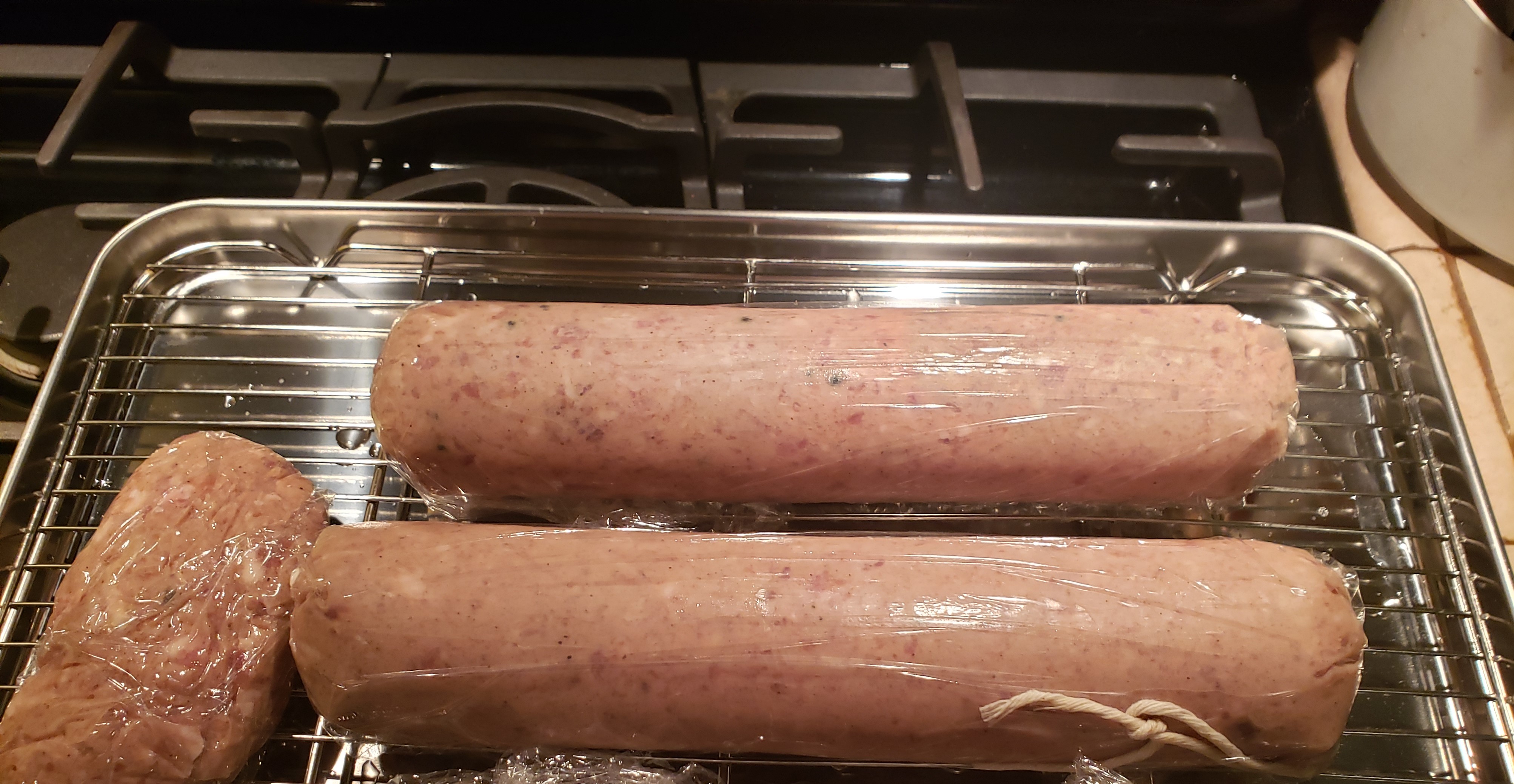
The dry sausage is in a collagen casing and then wrapped in saran wrap for the fermentation phase only, to maintain the very high humidity necessary for fermentation. The little mini one to the side is to measure the ph of meat so I don’t have to puncture the cased sausage. Once fermentation is complete the wrap is removed and the meat is put into a drying chamber. -
When doing dry sausage there are two totally different steps that make the meat safe and flavorful. Don’t confuse the fermentation process with the drying process they are completely different and have different goals.
You have to maintain 90% or higher RH for proper fermentation verses 80% RH in a drying chamber. Since fermentation lasts typically
 days at a set temp it just easier and just as effective to wrap for high humidity then place the “cased” meat in and actual chamber for the months of drying.
Ultimately if a person had unlimited space and money a separate fermentation chamber and drying chamber would be perfect, but for the home charcuterie maker I have found that keeping the fermentation process simplified is just as effective. If my sausage reaches the 4.9-5.2ph then I have achieved my goal of a safe product. PH keeps the meat safe, the high humidity allows for the fermentation to accomplish the lower PH, and the casings simply hold the meat together no more or no less.
Casings are not a barrier to pathogens in dried sausage products, with or without a casing the process still remains the same for a safe product.
-
When doing dry sausage there are two totally different steps that make the meat safe and flavorful. Don’t confuse the fermentation process with the drying process they are completely different and have different goals.
You have to maintain 90% or higher RH for proper fermentation verses 80% RH in a drying chamber. Since fermentation lasts typically
days at a set temp it just easier and just as effective to wrap for high humidity then place the “cased” meat in and actual chamber for the months of drying.Ultimately if a person had unlimited space and money a separate fermentation chamber and drying chamber would be perfect, but for the home charcuterie maker I have found that keeping the fermentation process simplified is just as effective. If my sausage reaches the 4.9-5.2ph then I have achieved my goal of a safe product. PH keeps the meat safe, the high humidity allows for the fermentation to accomplish the lower PH, and the casings simply hold the meat together no more or no less.
Casings are not a barrier to pathogens in dried sausage products, with or without a casing the process still remains the same for a safe product.

First pic shows the meat in my red neck fermentation cooler wrapped in plastic wrap to maintain a very high humidity. Second picture is the same cased sausage with wrap removed because it reached 4.9ph and I placed it in the drying chamber.

Notice the little one is not hanging because it was wrapped only in saran wrap for PH testing. Once my PH level is reached the little one goes to my trusted side kick for taste approval and for the record she loves it.
-
mrobisr I assume you heard us talking about not knowing if that was right or not on the podcast or livestream? Like I said, dry-cured is going to be a learning curve for me. In April I am going to Iowa State to take a dry-cured short course, so that should help!
Get more help with your processing questions and learn more about processing meat by subscribing to our waltonsinc.com youtube page at https://wltns.link/waltonstv I am a Gorilla, love yourself
-
mrobisr I assume you heard us talking about not knowing if that was right or not on the podcast or livestream? Like I said, dry-cured is going to be a learning curve for me. In April I am going to Iowa State to take a dry-cured short course, so that should help!
Jonathon I have read a lot of different materials from the USDA, .edu’s, and lots of ytube, but the best knowledge is in the book of
“THE ART OF MAKING FERMENTED SAUSAGES” by the Marianski’s
and second “Great Sausage Recipes and Meat Curing” by Rytek Kutas.The same rules apply to all foods cased or not cased as far as safe pathogen levels…
acid, water, sugar, salt, preservatives, temperature, and humidity.These references are other resources that I have read that have influenced my safe food production.
https://kb.osu.edu/handle/1811/45275?show=full
https://virginia-beach.ext.vt.edu/content/dam/virginia-beach_ext_vt_edu/files/4-h/20120223-AGR-EXT-DryCuringVirginiaStyleHam.pdf
http://www.cold.org.gr/library/downloads/Docs/Handbook of Food Preservation.PDF -
Jonathon I have read a lot of different materials from the USDA, .edu’s, and lots of ytube, but the best knowledge is in the book of
“THE ART OF MAKING FERMENTED SAUSAGES” by the Marianski’s
and second “Great Sausage Recipes and Meat Curing” by Rytek Kutas.The same rules apply to all foods cased or not cased as far as safe pathogen levels…
acid, water, sugar, salt, preservatives, temperature, and humidity.These references are other resources that I have read that have influenced my safe food production.
https://kb.osu.edu/handle/1811/45275?show=full
https://virginia-beach.ext.vt.edu/content/dam/virginia-beach_ext_vt_edu/files/4-h/20120223-AGR-EXT-DryCuringVirginiaStyleHam.pdf
http://www.cold.org.gr/library/downloads/Docs/Handbook of Food Preservation.PDFmrobisr Both great books. And thanks for those links, great info.
-
Jonathon I have read a lot of different materials from the USDA, .edu’s, and lots of ytube, but the best knowledge is in the book of
“THE ART OF MAKING FERMENTED SAUSAGES” by the Marianski’s
and second “Great Sausage Recipes and Meat Curing” by Rytek Kutas.The same rules apply to all foods cased or not cased as far as safe pathogen levels…
acid, water, sugar, salt, preservatives, temperature, and humidity.These references are other resources that I have read that have influenced my safe food production.
https://kb.osu.edu/handle/1811/45275?show=full
https://virginia-beach.ext.vt.edu/content/dam/virginia-beach_ext_vt_edu/files/4-h/20120223-AGR-EXT-DryCuringVirginiaStyleHam.pdf
http://www.cold.org.gr/library/downloads/Docs/Handbook of Food Preservation.PDFmrobisr thanks for the info.
-
Jonathon I have read a lot of different materials from the USDA, .edu’s, and lots of ytube, but the best knowledge is in the book of
“THE ART OF MAKING FERMENTED SAUSAGES” by the Marianski’s
and second “Great Sausage Recipes and Meat Curing” by Rytek Kutas.The same rules apply to all foods cased or not cased as far as safe pathogen levels…
acid, water, sugar, salt, preservatives, temperature, and humidity.These references are other resources that I have read that have influenced my safe food production.
https://kb.osu.edu/handle/1811/45275?show=full
https://virginia-beach.ext.vt.edu/content/dam/virginia-beach_ext_vt_edu/files/4-h/20120223-AGR-EXT-DryCuringVirginiaStyleHam.pdf
http://www.cold.org.gr/library/downloads/Docs/Handbook of Food Preservation.PDFmrobisr what are the thin sausages hanging to right in your pic?
I’m prepping for making semi dry pepperoni…





Hello! It looks like you're interested in this conversation, but you don't have an account yet.
Getting fed up of having to scroll through the same posts each visit? When you register for an account, you'll always come back to exactly where you were before, and choose to be notified of new replies (either via email, or push notification). You'll also be able to save bookmarks and upvote posts to show your appreciation to other community members.
With your input, this post could be even better 💗
Register LoginSponsored By: